
Shared Stories
International Media Art Festival 2026
LOOP Lab Busan
Artists
Marina Núñez
Cristina Lucas
Eugenio Ampudia
Carlos Casas
CuratedbyMenene Gras Balaguer
Director of Culture y Exhibitions – CASA ASIA
This Project gathers video installations that share the need to explore the present and future developments of video art. The three artists, Marina Núñez, Cristina Lucas, Eugenio Ampudia and Carlos Casas are Spanish born and they belong to a similar generation for which video was a medium to make a change in their art practices. All of them know that video art is in continuous evolution. For them it is crucial to understand that it constantly moves by adopting new forms.
The works that I gathered here are from artists who think their practice as a kind of translation of a language whose meaning is always in relationship with their narratives. They are all aware that the distance between video art and cinema is getting shorter and that both belong to a wider category related to the moving image. In the meetings of Barcelona last edition of LOOP (November 2025), artists and curators as well as art critics said that they had realized a big change towards video art and that maybe the best was concerning single channel video art works to consider them as short films instead of video art works.
As far as the actors play a role in the Spanish and Internacional art scene, I think it is important to take into account the way they think about the moving image and how they can teach us about narrating in one format or another and why they do this or the other. Each story is told connected to its narrative and to a process of construction on the basis of the artist understanding of spatiality and temporality. They all keep their individuality and singularity and the way they cross between themselves.
The installations should be shown in different locations despite belonging to the same project and they also need adequate space and follow the artists instructions for the setting up of the artwork as well as for its presentation. The artists should control the way their works must be shown. Myself as the curator I should also go to Busan during the LOOP. You will find the information about the artists and the works here below.
This project is supported by Casa Asia in terms of the curatorial practice, and it is possible thanks to the artists as well as to their galleries La Gran (Madrid), Rocío Santacruz (Barcelona), Albarran Bourdais (Madrid), Max Estrella (Madrid) and Gallery Ángels Barcelona (Barcelona).
Marina Núñez
WORKS: Nature | Island, Mangrove, Mountain, Forest (2019), 4 single-channel videos 2´each, (80inch screen), Vanishing (1-6), (2023), single-channel video, sound, 2´Videoprojection, 4K resolution. Music: Luis de la Torre and Mirage (1-20), (2023), single-channel video, sound, 39’. Videoprojection, HD resolution. Music: Luis de la Torre.
Courtesy of the artist, Gallery La Gran (Madrid) and RocíoSantaCruz Gallery (Barcelona).
Nature | Island, Mangrove, Mountain, Forest (2019). The project consists of four vases/trophies that exhibit -or enclose- four landscapes: a mountain, an island, a forest, a mangrove. The tiny scale of these ecosystems in relation to the containers shows our desire to domesticate, our desire to conquer. Subdued nature, a beautiful ornament for a cabinet of wonders. The grasses that grow rooted in the golden decorations can suggest, however, another relationship of forces.
-

- Isla.
-

- Manglar.
-

- Montaña.
-

- Bosque.
Vanishing (1-6), (2023), 2’ each.
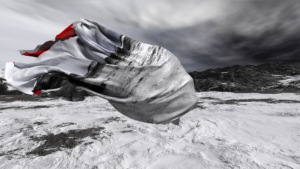
A landscape devoid of any trace of life transforms into a waving veil that covers a human head gazing in all directions, seeking understanding. The veil eventually lifts, revealing that the head does not exist. Perhaps it is an echo of the past, and the veil is a shroud. Only the Earth remains now. Although the cloudy sky may hint at a new future.
Mirage (1-20), (2023), single-channel video, sound, 39’.
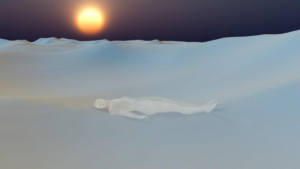
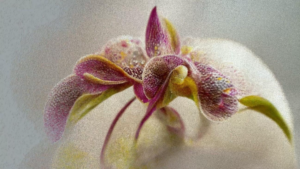
In a barren desert under scorching sun, a female body bursts apart. It was a body of sand. However, those grains fall to the ground drawing a flower. Perhaps a glimmer of life’s hope, or just a memory of what once was.
Cristina Lucas
WORKS: Chain Reaction Belt, 2025. Video composition: Ultrawide QHD* (3124x1200px) 2.603:1, 30 fps, color, stereo sound, 51’ 28’’, 20f (Project).
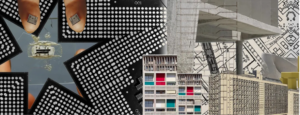
Courtesy of the artist and Gallery Albarran Bourdais (Madrid). Chain Reaction Belt , 2025
Chain Reaction Belt is a video presented in an ultrawide panoramic format. The piece unfolds as a moving visual timeline of the Anthropocene: a continuous belt-like sequence of images that traces the chain reactions triggered by technological innovation—from the steam engine to artificial intelligence.
The work reveals how each advance generates new disruptions and reconfigurations in the ways millions of people live, often accompanied by protests, legislative change, and structural transformations.
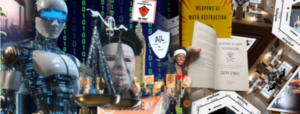
The video reflects on the technical meaning of “revolution” as a rotation, while showing how every technological shift reshapes society, biodiversity, and geopolitics. The piece concludes with a desired horizon: an empowered society demanding balance between the planet, technology, and privacy.
Technical Datasheet
Projection system (Based on the audiovisual installation specifications for Albarrán Bourdais)
- Two laser projectors 7500 lumens, short-throw optics
- Model: Optoma ZU720TST
- Professional ceiling mount, high-precision, vibration-free
- Blending and mapping workflow
- Work carried out from a master file at 3124 × 1200 px
- Generation of two synchronized files for perfect alignment in exhibition
- On-site colorimetry and screen adjustment
Sound system
- 2 × Dynaudio BM5 MKIII active speakers
- 2 × wall-mounted inclinable supports
- Subwoofer AMC SBS10, 10” active sub
- Frequency response: 20 Hz – 200 Hz
- Amplification: 160 W (sub) + 2 × 60 W (external speakers)
Playback system
- Frame-accurate 4K playback system (BS 4K)
- Programming and synchronization included
Installation & maintenance
- Complete installation by AV technicians: video lines (HDMI/DVI), control, audio, and power
- Calibration: screen alignment, blending, color, sound EQ
- Maintenance for the full exhibition period
- Dismantling at end of show.
Video Projection
The projection of “Chain Reaction Belt” was displayed on a wall measuring 4.11 meters in height and 10.86 meters in length, allowing the ultrawide panoramic format (3124 × 1200 px, 2.603:1) to unfold at an immersive architectural scale. This expansive horizontal surface reinforces the concept of a “moving belt,” enhancing the reading of the video as a continuous visual chronology *.
Using a high-luminance laser projector, calibrated through a blending and colour-adjustment workflow, the installation ensured a sharp, evenly distributed image across the entire width of the wall. The monumental scale of the projection envelops the viewer within the unfolding sequence, deepening the experience of the historical, technological, and social processes presented as an unbroken chain of causes and effects.
* If the room depth allows it, a single projector would be enough to achieve the same image size as described. This means it could be done, provided the distance between the projector and the screen or wall is sufficient for the required image dimensions. In this case, a 10,000-lumen projector would likely suffice.
Eugenio Ampudia
WORKS: Concert for the Biocene (single-channel video), Around the Prado Museum (single-channel video), Where to sleep 5 Palau (single-channel video) and Kicking Rights Up (single-channel video).
Courtesy of the artist and the Gallery Max Estrella (Madrid)
Concert for the Biocene, 7´30”, 2022
Concert for the Biocene is one of Ampudia’s latest research related to the necessity of reformulating the present from post-humanist postulates and eco-social compromise.
An action hosted by the artist at Barcelona’s El Liceu Teatre in June 2020, on the occasion of the institution’s reopening after the end of lockdown. Ampudia creates a concert for plants as a symbolic action for a paradigm swift. A total of 2.292 plants, the full capacity of the theatre, enjoyed Giacomo Puccini’s piece “Crisantemi” by a string quartet.
The concept Biocene –suggested by Blanca de la Torre, curator of the action–replaces the term known as Anthropocene, which defines the most recent history of deterioration of our planet due to human impact. Biocene, therefore appeals to the beginning of a new era that finally places life in the center.
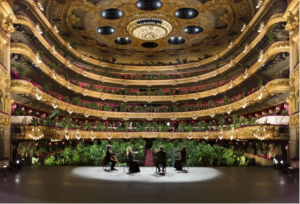
The Concert for the Biocene is the result of an initiative by the artistic director of the Gran Teatre del Liceu, Víctor Garcia de Gomar, and the artist, together with the Max Estrella Gallery and Blanca De La Torre, as curator. With the documentation material of the artistic action, Eugenio Ampudia produced a video-art piece and several large-format photographs.
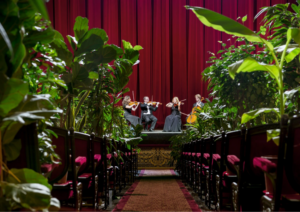
Concert for the Biocene (2020), 7´30”.
Around the Prado Museum, 1´40” (single-channel video), 2019
“LaVuelta”, thus in noun, crosses the country circulating through its arteries or, to be more precise, through the furrows already defined in its skin. He had never slipped inside before. Until now. A group of cyclists crosses “El Prado” and makes it the scene of their frenzy. Art, culture, history become witnesses first, then spectators and end up as actors of that unusual representation.
Where to Sleep 5, 5´44´ (single-channel projection with audio), 2015
Since 2008 the artist has been sleeping overnight in various iconic places for culture and the history of art. He started the series at the Prado museum, sleeping under Goya’s The Third of May 1808, before continuing it at the Alhambra in Granada, at the ARCO art fair in Madrid, at the library in the Ajuda National Palace in Lisbon and more recently at the Palau de la Música in Barcelona.
Throughout the ongoing series, the action is based on sleeping inside a space consecrated to art, something we have traditionally viewed as illegal or subversive. Underlying the simplicity of the gesture is Ampudia’s rejection of certain attitudes within the art world which are taken as givens and then accepted as conventions.
The act of sleeping has been given different connotations in the period of political unrest over recent years and the appearance of movements like 15-M, Occupy Wall Street, Occupy Museums, etc., and it has become an act of resistance in itself and a declaration of intent.
On the other hand, the gesture of sleeping in a public space has always been associated with marginality and situations of transit in some “non-place”—on a long journey or a stopover in an airport—or vulnerability, all of which stand as metaphors which fit fairly well with the situation art and culture has been going through in Spain since the artist started the series.
Yet the positive attitude in Ampudia’s works is more akin to the act of dreaming, of producing ideas, of rethinking and continuing to dream of utopia, what keeps us going and against which we must adopt a political stance.
Throughout the history of art there has been a constant focus on the act of sleeping as a subversive and basic gesture when it comes to analysing our role as individuals in the construction of the social space. Ranging from the sculptures of sleeping Eros which decorated Roman villas in the Hellenistic period to The Sleep of Reason Produces Monsters by Goya, later reinterpreted so well by the British artist Yinka Shonibare, The Nightmare by Henry Fuseli, Dream Caused by the Flight of a Bee Around a Pomegranate a Second Before Awakening by Salvador Dalí, or the many works of his surrealist colleagues, to mention a few evident examples.
Another more contemporary historiographic example featuring Morpheus is the celebrated film Sleep, Andy Warhol’s first, where the actor John Giorno sleeps for over five hours. Tilda Swinton slept for eight hours every day in a glass vitrine at the Serpentine Gallery, in The Maybe by Cornelia Parker. Likewise, as part of their search for a new lover, the Israeli artists Gil and Moti slept in a New York art gallery in their work Sleeping With the Enemy. In The Sleepers, Sophie Calle, in turn, invites different people, mostly unknown, to sleep in her bed so that she can photograph them.
Some institutions have even agreed to be used as a kind of hotel, like the Guggenheim in New York, which a few years ago hosted the work Revolving Hotel Room by the Belgian artist Carsten Höller. For the “trifling” sum of 300 dollars (which was tripled on public holidays) visitors could spend the night in the museum. And to shift our focus to a case closer at hand, ARTIUM in Vitoria, in an initiative proposed by the art group Fundación Rodríguez, staged a collective sleepover as one of the actions to undertake a rereading of the museum’s collection.
And we have a more recent example from the Chinese artist Zhou Jie, in her exhibition last summer at Beijing Now Art Gallery in Beijing called 36 Days, in which she slept on a bed of unfinished iron wires for the duration indicated in the title of the work, including visits from her partner.
While one can inevitably associate all these examples with a certain patina of fetishism, with a titillation for sleeping in an institutional space—exemplifying the normative and conventional—it is probably more a case of a profound reflection on the nature of dreams and the way in which these are projected onto the individual; an open process that Ampudia continues in order to rethink the codes and structures of contemporary art, as well as the critical situation it currently finds itself in.
With this act he also wishes to divest himself of his artist-self to show his more immediate self, and at once to transform the space of art into a much proximate place, into a space of art closer to all, to make us feel at home. In this way he proposes a reformulation of our concept of dwelling, which, through a process of repeating the action in various iconic places, convinces the spectator that his relationship with these places should be more relaxed and that he should view them as belonging to him. Once again, it reminds us to make ourselves comfortable, that the public space belongs to all of us; and yet again, that this relaxed attitude to the temples of art is another way of rewriting history or at least of introducing new chapters…(From Blanca de la Torre essay about the artist and this work).
Kicking Rights Cup, 2´28´´ (single-channel video) 2022
Kicking Rights Cup (2022), produced in collaboration with APDHE (Asociación Pro Derechos Humanos, España), this video was created as a critical response to the human rights violations associated with the World Cup in Qatar, coinciding with the 75th anniversary of the Universal Declaration of Human Rights. In it, Ampudia has replaced the soccer ball with the book Universal Declaration of Human Rights, questioning the dominant uncritical view that the entertainment industry overlooks and drawing on Peter Sloterdijk’s (2006) reflections on soccer culture, in which the thinker compares a soccer match to a hunting scene.
Carlos Casas
Works: Cemetery (film, video, color, sound) and Deserts (single-channel vídeo)
Courtesy of the artist and the Gallerie Àngels Barcelona (Barcelona).
Cemetery (85´, 2019) is a deeply sensory film that follows an elephant, a mahout and the poachers in their pursuit as they move toward the mythical place known as the elephant graveyard. As the journey transitions from the jungle through stages of death, images begin to fall away, opening onto a rich sonic landscape.
Ten years in the making, Cemetery weaves together field recordings from around the globe, recorded and mixed by wildlife sound expert Chris Watson with the collaboration of Professor Tony Myatt (spatialisation and Ambisonics). Finding a striking juncture between nature documentary, experimental film, road movie and soundscape, the film opens up questions about life cycles and memory, colonialism and extinction, conservation and the environment and interspecies relationships.
“The myth of the cemetery remains ever more urgent today, and it’s today that its meaning is more pertinent: to somehow illuminate a new vision of nature and our position within it. My challenge was to uncover that myth in order to present it anew, to make a contemporary reading of it, and experiment with different visual and sonic languages. I consider this film as the ultimate battle of vision and sound, hearing and seeing. For me, this film concludes a journey, a personal cinematic exploration process to question sound in the wider cinematic experience. In a era where film is becoming more a distraction, I wanted to create a film that is not a commodity, that demands as much from viewers as it gives, a film that somehow hands viewers a larger responsibility: forcing them to become the projectors or creators as well, using their own experience, to project their own images, their own light. I wanted to make a film that folds onto itself and changes, that finally uses our sleep as tool for filmmaker/audience interaction. I wanted to create a manifold film, a “machine of perception” to quote Snow, but also a film that speaks to our childlike, oneiric side. A film that would use darkness to create itself. Along the way, while preparing this film I asked myself a lot of questions that will be left unanswered, but that will populate the film like ghosts. Maybe there is a way to find new means by which to understand our position and our responsibility as species, and also as viewers. Maybe if only we allowed ourselves to be reawakened, reincarnated cinematically and maybe even spiritually, perhaps then we could answer the question: does our journey end here or does it continue?” By Carlos Casas, “Notes on a film about elephants,” a text by Carlos Casas published in his forthcoming book Cemetery. Journeys to the elephant graveyard and beyond by Humboldt books.
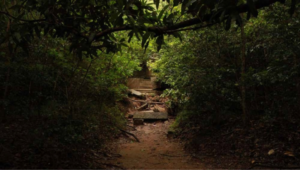
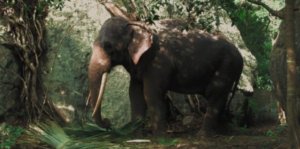
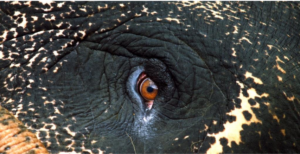
Cemetery (2019) | Film, video, color, sound, 85
Deserts (2024) is another project in development by Carlos Casas, inspired by the innovative piece Déserts from Edgar Varèse. Originally conceived as an audiovisual project, Déserts became a kind of “El Dorado” from what can be a musical movie: a model for the advance and potential of the audiovisual work and a lighthouse of hope for new directions in the audiovisual language. Fascinated by the project and Varès’s vision, Casas expands its own “visual sound” research. Experiments not only with new forms of presenting image and sound, if not with innovative methods to work with archive material. The artist explores both environmental degradation, such as desertification, and psychological landscapes of solitude and mystery.
The project emerges from the fascination of Casas for the concept of “desert” from Varèse as a metaphor of both ambience desolation and existential solitude. Casas is based on Varèse’s words: “Déserts don’t address only the physical deserts made of sand, sea, mountains, and snow, from the exterior space, the streets of desert cities… if not also from a far interior space… where the man is alone in a world of mistery and essential solitude.”
This film is the subconscious pair of the main film, it works as a B side or retro projection, as a shadow or complementary element. This work it’s a complimentary piece of the film Deserts 1.8. It features new ways of organizing archive and allows to subconscious and subliminal go through the whole archive. It becomes an hypnotic complement and also a system to create new connections with images overlaying different themes and thematics strands of archive in order to possibly allow new meanings and possible connections.
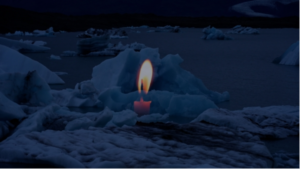
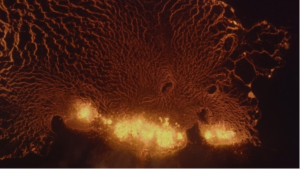
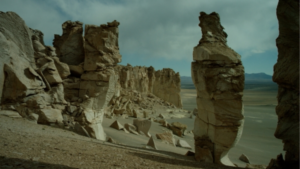
Deserts (2024) | Film, 24’ 41’’
 Casa Àsia | Seu Social
